
MACHINE & TOOLSPROCESS DEVELOPMENTROBOTIC 3D PRINTING
INTEGRATED DESIGN, ENGINEERING & PERFORMANCE OPTIMIZATION
One model. Every scale. Design, engineering, and fabrication, permanently aligned.
Engineering a product means more than resolving its geometry. It means building a model that carries construction logic, technical properties, BIM data, and performance constraints as a single coherent structure — one that remains consistent as the design evolves.
AIVOX develops parametric digital twins, multi-scale simulation environments, and fabrication-aware design systems that keep design, engineering, and information permanently aligned — from the component to the full architectural configuration.
The process
01 // Parametric Data Driven
The digital model is not a geometric representation — it is an engineered system.
Construction logic, technical specifications, material properties, and BIM information are embedded as parameters, not annotations.
Every design change propagates in a controlled way across all levels: geometry, engineering data, and information outputs update together.
- Complete parametric digital twins
- BIM integration and design software interoperability
- Automated information management
- Fully engineered product models
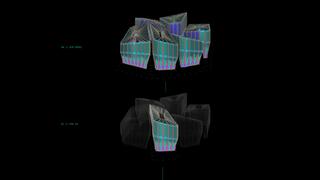

02 // Multi-Scale Simulation and Optimization
From the single component to the full architectural configuration, AIVOX develops simulation systems that evaluate complex behavior across scales, supporting design decisions with comparative data and scenario analysis. Product, construction system, and architectural space are assessed within a single environment — consistency across scales is built into the model.
Multi-scale, multi-objective simulation models
Data for design evaluation and decision support
Data-driven scenario and configuration generation
Structured datasets ready for BIM workflows
03 // Complex Geometry and Fabrication-Aware Design
Geometric complexity is not a constraint to be managed after the design is resolved — it is a parameter to be controlled from the start. AIVOX develops rationalization strategies for non-standard geometries: double-curvature surfaces, non-developable forms, and topologically differentiated component families are brought into alignment with fabrication constraints without losing formal intent.
Why DfMA?
DfMA logic is embedded in the parametric model — connection geometry, tolerance management, assembly sequencing, and production constraints are co-designed with the form, not resolved as corrections downstream.
- Geometric rationalization for complex surfaces
- DfMA-integrated parametric models
- Assembly management systems
- Component families with shared fabrication logic
Every parameter is engineered, not decorative: structural logic, tolerances, and material behavior live inside the model itself. Simulation and DfMA constraints are resolved at the design stage, not discovered during production — reducing rework and giving you full traceability from calculation to component.
Formal complexity doesn't have to mean loss of control. AIVOX rationalizes double-curvature surfaces and non-standard geometries while preserving design intent, so your architectural vision stays intact as it moves through engineering, simulation, and fabrication.
Assembly logic, tolerances, and sequencing are defined upstream, inside the parametric model — not improvised on site. Component families share fabrication logic, which means fewer surprises during production and a smoother, more predictable path from model to built structure.

_____________________________________________________________________________________________________________________________________________________________
Explore the process with AIVOX
The AIVOX team supports designers, researchers and institutions from project analysis through to production.