Product development
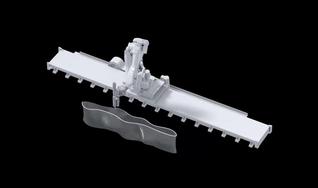
We do not design objects. We design dynamic product systems.
The difference is substantial: an object is produced once. A product system scales, adapts, and optimizes — without starting from scratch every time.
Geometry, materials, and performance are not defined sequentially, but in an integrated way: every design decision is already a production decision.
The result is a parametric and generative model that doesn't just sit in a drawer, but directly drives downstream processes.
What you actually get:
Product families and controlled variants — parametric and generative systems that manage tens or hundreds of variants without multiplying development work.
Digital Twins and computational analysis — performance, constraints, and feasibility verified in simulation, before touching physical materials.
CAD / BIM (AEC) interoperability — coordinated project data flowing across different environments without information loss.
DfMA (Design for Manufacture and Assembly) — design conceived for automated production and assembly: less waste, less rework, and faster time to production.
If you are managing product complexity with sequential tools, you are already losing time and margins. Let's talk.
Software Development
Software is not an add-on. It is what orchestrates and ties everything together.
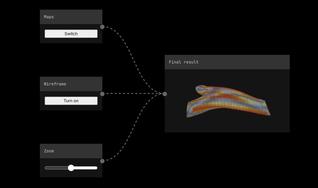
Design, simulation, production: when these three worlds speak different languages, information gets lost, cycles lengthen, and errors become costly.
Our software tools eliminate these gaps—not by implementing standard platforms, but by building exactly what is needed, exactly where it is needed.
Custom tools, automated pipelines, consistent 3D environments: your workflow stops being a collection of disjointed software and becomes a self-governing system.
What you actually get:
Custom software tools — standalone or web-based, designed around your specific process, not a generic use case.
Pipeline automation — parameters, validation, simulation, and exports orchestrated seamlessly and traceably.
Consistent 3D environments — the same model used in design, testing, and production, without lossy conversions.
Integration with your existing ecosystems — PLM, CAM, MES: when necessary, the system connects to what you already have in place.
If your team spends more time exporting, converting, and reconciling files than actually designing, there is a system that needs to be built. Let's start with an audit.
Software Development
Software is not an add-on. It is what orchestrates and ties everything together.
Design, simulation, production: when these three worlds speak different languages, information gets lost, cycles lengthen, and errors become costly.
Our software tools eliminate these gaps—not by implementing standard platforms, but by building exactly what is needed, exactly where it is needed.
Custom tools, automated pipelines, consistent 3D environments: your workflow stops being a collection of disjointed software and becomes a self-governing system.
What you actually get:
Custom software tools — standalone or web-based, designed around your specific process, not a generic use case.
Pipeline automation — parameters, validation, simulation, and exports orchestrated seamlessly and traceably.
Consistent 3D environments — the same model used in design, testing, and production, without lossy conversions.
Integration with your existing ecosystems — PLM, CAM, MES: when necessary, the system connects to what you already have in place.
If your team spends more time exporting, converting, and reconciling files than actually designing, there is a system that needs to be built. Let's start with an audit.
Process Development
The process is not the final stage. It is the starting point.
In advanced manufacturing, the boundary between design and production is a costly illusion.
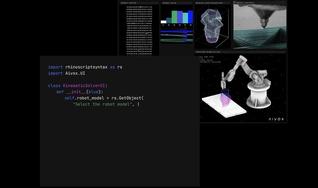
We develop fabrication strategies that enter the design process right from the early stages — not as a constraint, but as an active decision-making tool.
We work on systems where geometry is complex, materials are non-standard, and traditional processes are not enough. Here, we do not adapt existing solutions: we build the right production strategy for your specific system.
What you concretely get:
Non-standard robotic processes — additive, subtractive, hybrid: we select and integrate technology based on the desired result, not a catalog.
Production strategies for complex geometries and advanced materials — where others stop, we build the method.
Off-site / on-site workflows — designed where it makes sense for the system, not out of habit.
- Validation through physical testing and iterative feedback — the model confronts reality, corrects itself, and improves.
If your production is blocked by geometries that "cannot be made" or by processes that do not scale, that is exactly the kind of problem we solve.
Process Development
The process is not the final stage. It is the starting point.
In advanced manufacturing, the boundary between design and production is a costly illusion.
We develop fabrication strategies that enter the design process right from the early stages — not as a constraint, but as an active decision-making tool.
We work on systems where geometry is complex, materials are non-standard, and traditional processes are not enough. Here, we do not adapt existing solutions: we build the right production strategy for your specific system.
What you concretely get:
Non-standard robotic processes — additive, subtractive, hybrid: we select and integrate technology based on the desired result, not a catalog.
Production strategies for complex geometries and advanced materials — where others stop, we build the method.
Off-site / on-site workflows — designed where it makes sense for the system, not out of habit.
- Validation through physical testing and iterative feedback — the model confronts reality, corrects itself, and improves.
If your production is blocked by geometries that "cannot be made" or by processes that do not scale, that is exactly the kind of problem we solve.